


Cannabinoid Profile (Potency) Testing
A commitment to consistent, accurate results.

One of the main reasons for cannabinoid testing is to determine the potency of a cannabis product. Cannabinoids are the actives present in Cannabis that give the product both its medicinal and psychoactive properties. Cannabinoid content must be measured and reported on the product. This is especially important for medical cannabis patients, who may require precise dosing to manage their symptoms. Accurate potency testing allows patients to know exactly how much of a particular cannabinoid, such as THC or CBD, they are consuming. It also helps ensure that products labeled as having a certain cannabinoid level actually contain the amount stated on the label.
The Cannabis Act requires the following cannabinoids be quantitatively measured:
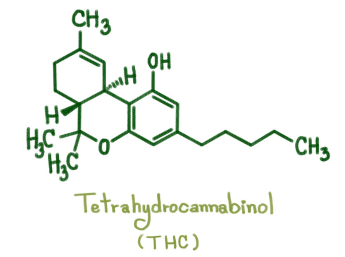
Tetrahydrocannabinol
Tetrahydrocannabinol, commonly known as THC, stands as the primary psychoactive element found in cannabis and is among over 113 cannabinoids recognized in the plant. Despite the existence of multiple isomers in the chemical formula for THC, the term typically denotes the delta-9-THC isomer, scientifically referred to as trans-Δ⁹-tetrahydrocannabinol.
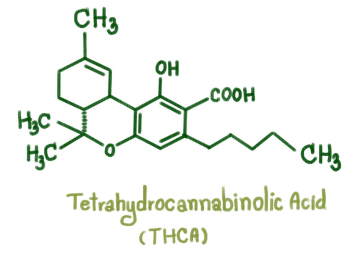
Tetrahydrocannabinolic Acid
Tetrahydrocannabinolic acid (THCA) serves as a precursor to tetrahydrocannabinol (THC), a key active component in cannabis. THCA is present in varying amounts in fresh, non-dried cannabis; however, it undergoes gradual decarboxylation, transforming into THC through processes like drying and particularly intense heating, as seen in smoking or cooking cannabis for edibles. In cannabis resin concentrates like hashish and hash oil, derived from high-THC fresh plant material, THCA often constitutes the majority, often ranging from 50% to 90% by weight.
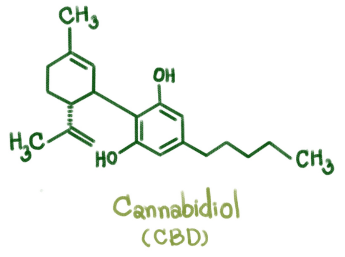
Cannabidiol
Cannabidiol (CBD) stands as a phytocannabinoid, one among the 113 identified cannabinoids within cannabis plants, sharing the stage with tetrahydrocannabinol (THC). It constitutes a significant portion, up to 40%, of the plant's extract. CBD, also known as cannabidiol, holds the position of the second most abundant active compound in cannabis, commonly referred to as marijuana. Although CBD plays a crucial role in medical marijuana, it is sourced directly from the hemp plant, which is a relative of marijuana, or it can be synthesized in a laboratory.
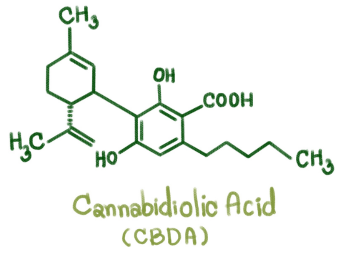
Cannabinolic Acid
Cannabidiolic acid (CBDA) is a cannabinoid present in cannabis plants, primarily concentrated in the glandular trichomes of female seedless flowers, commonly known as buds. CBDA serves as the chemical precursor to cannabidiol (CBD). The conversion of CBDA to CBD occurs through decarboxylation, involving the removal of a carbon and two oxygen atoms from the 1 position of the benzoic acid ring. Cannabinoids, a distinctive class of compounds, are essentially exclusive to the cannabis genus.
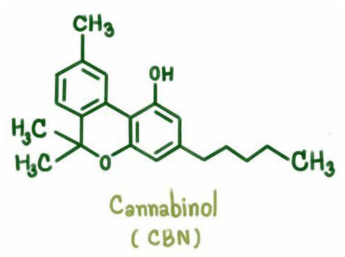
Cannabinol
Cannabinol, commonly known as CBN, is a mildly psychoactive component present in cannabis. Similar to the potent psychoactive THC, CBN is derived from tetrahydrocannabinolic acid (THC-A). The formation of CBN occurs through the oxidation of THC-A.
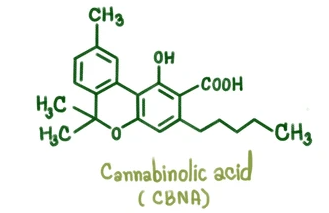
Cannabinolic Acid
Cannabinol, commonly known as CBN, is a mildly psychoactive component present in cannabis. Similar to the potent psychoactive THC, CBN is derived from tetrahydrocannabinolic acid (THC-A). The formation of CBN occurs through the oxidation of THC-A.
We have a validated an in house method using an HPLC and UV detector. We also have an expanded method that can measure additional Cannabinoids including
CBG (Cannabigerol)
Cannabigerol (CBG), a cannabinoid present in the cannabis plant, is frequently hailed as the "mother of all cannabinoids." This designation arises from the fact that other cannabinoids originate from cannabigerolic acid (CBGA), which is the acidic precursor to CBG. CBG is generally present in lower quantities compared to other cannabinoids like cannabidiol (CBD) and tetrahydrocannabinol (THC) in cannabis plants.
CBGA (Cannabigerolic Acid)
Cannabigerolic acid (CBGA) represents the acidic variant of cannabigerol (CBG). Structurally, it comprises dihydroxybenzoic acid and olivetolic acid, with a geranyl group substituting the hydrogen at position 3. This compound serves as a biosynthetic precursor to Delta-9-tetrahydrocannabinol, the primary psychoactive element in the Cannabis plant. CBGA is categorized as a meroterpenoid, belonging to both polyketide and terpenoid classes, and is a member of resorcinols and phytocannabinoids. Its origin can be traced back to olivetolic acid, and it functions as the conjugate acid of a cannabigerolate.
CBC (Cannabichromene)
Cannabichromene (CBC), alternatively known as cannabichrome, cannanbichromene, pentylcannabichromene, or cannabinochromene, demonstrates anti-inflammatory properties in vitro, suggesting a potential contribution to the analgesic effects of cannabis. As a phytocannabinoid, CBC is one among numerous cannabinoids found in the Cannabis plant. Its structural resemblance to other natural cannabinoids, such as tetrahydrocannabinol (THC), tetrahydrocannabivarin (THCV), cannabidiol (CBD), and cannabinol (CBN), establishes a commonality. Both CBC and cannabinols are present constituents in cannabis.
CBCA (Cannabichromenic Acid)
Cannabichromenic acid is a chromenol characterized by the substitution of methyl, 2-methylpent-2-en-5-yl, hydroxy, carboxy, and pentyl groups at positions 2, 2, 5, 6, and 7, respectively, in the 2H-chromene structure. This compound functions as both an antibacterial agent and a plant metabolite. Classified as a phytocannabinoid, it falls under the categories of a hydroxy monocarboxylic acid, a chromenol, and an olefinic compound. Additionally, it acts as the conjugate acid of a cannabichromenate.
Δ8-THC (Delta-8-Tetrahydrocannabinol)
Δ8-THC, a minor cannabinoid in the cannabis plant, is an isomer of Delta-9-Tetrahydrocannabinol (Δ9-THC), differing only in the position of a double bond on its carbon chain. While structurally similar to Δ9-THC, Δ8-THC exhibits slightly less psychoactive potency and may provide a milder, more clear-headed effect. This cannabinoid is often found in trace amounts but can be produced through the isomerization of CBD or Δ9-THC. Δ8-THC is valued for its potential therapeutic properties, including anti-nausea, appetite-stimulating, and anxiety-reducing effects.
Δ9-THC (Delta-9-Tetrahydrocannabinol)
Δ9-THC, or Delta-9-Tetrahydrocannabinol, is the primary psychoactive compound in cannabis, responsible for its characteristic "high." This cannabinoid interacts with the body's endocannabinoid system by binding to CB1 receptors in the brain and nervous system. Δ9-THC is derived from its acidic precursor, THCA, through decarboxylation. In addition to its psychoactive effects, Δ9-THC is studied for its potential therapeutic applications, including pain relief, anti-inflammatory effects, and appetite stimulation.
CBL (Cannabicyclol)
Cannabicyclol (CBL) is a non-psychoactive cannabinoid found in aged cannabis. It forms through the degradation of other cannabinoids, particularly CBC (Cannabichromene), under exposure to light and heat. While CBL is present in minimal quantities in most cannabis strains, its exact effects and therapeutic potential are still under research. CBL's structure features a bicyclic framework, distinguishing it from other phytocannabinoids.
CBDV (Cannabidivarin)
Cannabidivarin (CBDV) is a non-psychoactive cannabinoid structurally similar to cannabidiol (CBD), differing only by a shortened side chain. CBDV is most commonly found in cannabis strains with low THC content and is being studied for its potential to treat conditions such as epilepsy, autism spectrum disorders, and nausea. Its lack of intoxicating effects makes it a promising candidate for therapeutic applications.
CBDVA (Cannabidivarinic Acid)
Cannabidivarinic acid (CBDVA) is the acidic precursor to Cannabidivarin (CBDV). Structurally, it contains an extra carboxyl group, making it part of the phytocannabinoid acids found in raw cannabis. CBDVA decarboxylates into CBDV upon exposure to heat. Like CBDV, CBDVA is non-psychoactive and under investigation for its potential role in managing neurological disorders and inflammation.
THCV (Tetrahydrocannabivarin)
Tetrahydrocannabivarin (THCV) is a cannabinoid structurally similar to THC but with a shorter side chain. THCV interacts with the endocannabinoid system differently, acting as a CB1 receptor antagonist at low doses and an agonist at higher doses. Known for its potential appetite-suppressing properties, THCV is being studied for its therapeutic effects on conditions such as obesity, diabetes, and anxiety.
THCVA (Tetrahydrocannabivarinic Acid)
Tetrahydrocannabivarinic acid (THCVA) is the acidic precursor to THCV, found in raw cannabis plants. It contains an additional carboxyl group, which is removed during decarboxylation to form THCV. Like other cannabinoid acids, THCVA is non-psychoactive and may contribute to the plant's anti-inflammatory and therapeutic potential.
CBLA (Cannabicyclolic Acid)
Cannabicyclolic acid (CBLA) is the acidic form of Cannabicyclol (CBL). It is a minor cannabinoid produced during the degradation of CBC (Cannabichromene) under the influence of light and oxygen. CBLA exists predominantly in aged cannabis and has a bicyclic structure. Its pharmacological properties remain largely unexplored, though it holds potential for therapeutic applications due to its structural similarities to other cannabinoids.
Pharmacopoeial Testing
We also perform cannabinoid testing as per the German Monograph, the German Pharmacopoeia, and the European Pharmacopoeia (EP). These methods are verified for use with fresh, dried, and extracted cannabis oil products.
Let's Connect
We deliver quality in all of our work, providing accurate results on time.


